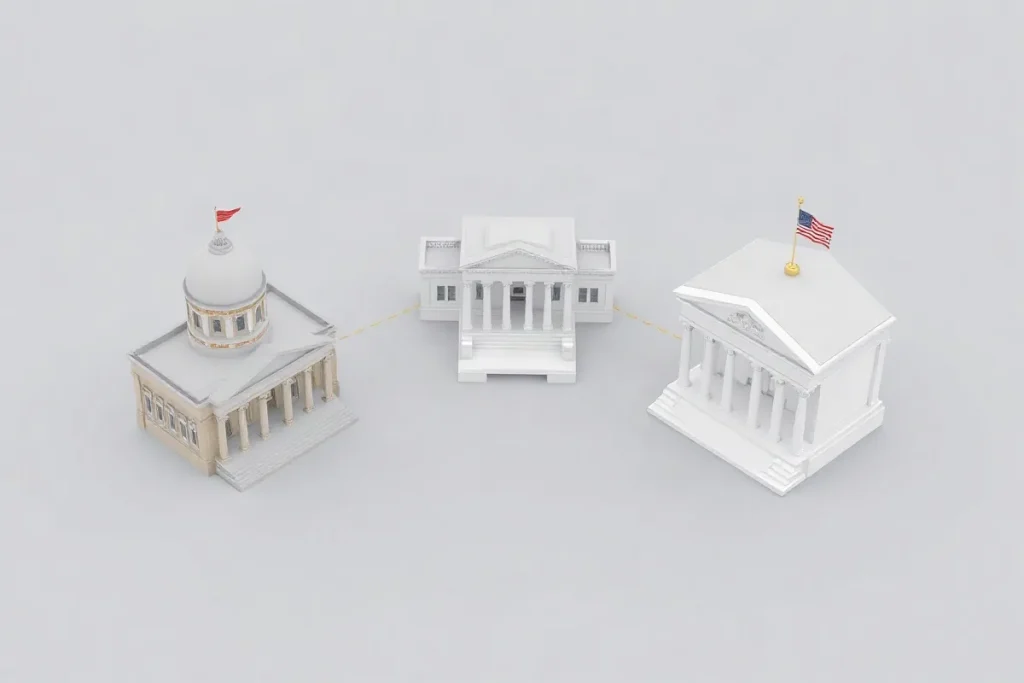
The three branches of U.S. government share power: Congress makes laws, the president carries them out, and the courts interpret them. Each can also limit the others.
This system is designed to prevent any one branch from acting without checks. In practice, the branches interact through lawmaking, executive decisions and court rulings—sometimes cooperating, sometimes contesting where authority lies.
| Branch | Main role | Concrete example |
|---|---|---|
| Legislative | Makes federal laws | Congress includes the House and Senate |
| Executive | Carries out federal laws | The State Department negotiates treaties |
| Judicial | Interprets laws and reviews constitutionality | The Supreme Court can overturn unconstitutional laws |
- 100 senators Senate membership
- 435 members House membership
- 1884 Year the University of Michigan became a Federal Depository Library
Why is it wrong to treat the president as the whole executive branch?
It is wrong to treat the president as the whole executive branch because the president leads a larger system of departments and agencies that carries out federal law.
The president’s leadership role is distinct from the work performed across executive offices. The State Department, for example, negotiates treaties and agreements with foreign entities and represents the United States at the United Nations. Those duties belong to the department’s work within the executive branch; they are not the same as the president’s role in leading it.
Leadership and administration
The distinction matters when you want to understand how federal power operates. The president leads the branch, while departments and agencies perform the work of administering federal law. A closer look at the executive branch’s structure and responsibilities can show how those roles fit together.
Why are the House and Senate not interchangeable?
The House and Senate are not interchangeable because Congress is made up of two chambers with different representation: the Senate gives each state equal representation, while House seats are distributed by state population.
Congress is the legislative branch of the federal government. The Senate has 100 senators, with two per state; the House of Representatives has 435 members, with seats distributed by state population. Together, the chambers make federal laws, while the executive branch carries them out.
- Senate: Each state has two senators, regardless of its population.
- House of Representatives: The number of seats a state receives reflects its population.
When you hear that a bill is being discussed, check whether the action is in the House, the Senate or Congress as a whole. The chamber matters: a reference to Congress may mean both, while a House or Senate reference identifies one of its parts.
What can courts do—and what can they not do?
Courts interpret laws and decide whether they comply with the Constitution; they can overturn unconstitutional laws, but they cannot write or enforce them.
The Supreme Court’s power to overturn an unconstitutional law checks Congress and government action. It can also remove the president from office in exceptional circumstances. These are judicial powers, not a general authority to set policy or carry out government decisions.
Interpreting a law is not making one
When a court decides what a law means in a dispute, it applies the law to that case. Deciding whether Congress should pass the law is a separate question for the legislative branch. Courts can rule on constitutionality, but they do not replace Congress’s role in choosing and enacting laws.
Enforcement belongs to the executive branch. A court’s ruling can settle a legal dispute or invalidate a law; putting government policy into effect is not the court’s job.
How do the three branches check one another without doing the same job?
Congress writes federal laws, the executive branch administers them, and the courts resolve disputes over what those laws mean and whether they are constitutional.
That division lets each branch check the others without taking over their central work. Congress can use impeachment to seek the president’s removal from office in exceptional circumstances; impeachment is a congressional check, not a routine executive procedure. The Supreme Court can overturn laws it finds unconstitutional, limiting what Congress may enact.
Start with the action
To identify which branch is responsible for a specific question, first ask what is happening to the law:
- Passing: Congress writes and enacts federal laws.
- Carrying out: The executive branch administers federal laws.
- Interpreting: Courts resolve disputes about a law’s meaning and constitutionality.
A dispute can involve more than one branch: Congress may pass a law, the executive may administer it, and a court may later rule on its meaning or constitutionality. The action at issue tells you which branch’s role to examine first.
What can you check when the branches disagree?
When the branches disagree, start with the specific bill, law, court decision or executive action in dispute; each points to a different part of the process.
A government document can help you separate what a law says from how a court interprets it or how an agency puts it into practice. The University of Michigan has been a Federal Depository Library since 1884, and its federal collections include bills, laws and government reports.
- Bill or law: Check the document’s text to identify what Congress proposed or enacted.
- Court decision: Read the decision to see how a court interpreted the law.
- Agency action: Look for the agency’s document explaining how it is implementing the law.
The three-branch summary is useful, but it has limits. A branch can contain multiple offices, and a question about federalism—the division of power between the federal government and the states—may involve state governments too. Check which office acted and whether a state government is part of the dispute.
Frequently asked questions
What are the 3 branches of gov?
What is the difference between the House and the Senate?
Can the Supreme Court overturn a law?
Is the president the entire executive branch?
Sources
- USAGov — “Branches of the U.S. government”
- research.ewu.edu — “Federal Government – Federal Government Information – Research Guides at Eastern Washington University”
- guides.lib.umich.edu — “Starting your Research – United States Government Information – Research Guides at University of Michigan Library”
- nibble-app.com — “Three Branches of Government: How the System Works – Nibble Blog”