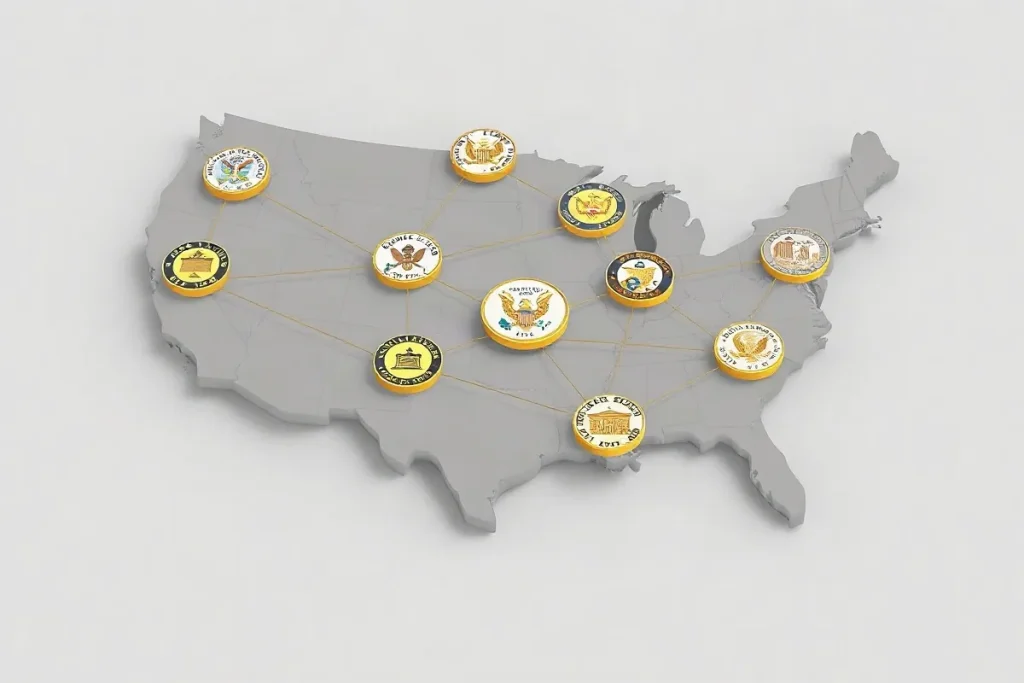
The Full Faith and Credit Clause serves as a vital mechanism in maintaining legal consistency across states in the United States. By requiring each state to recognize and honor the public acts, records, and judicial proceedings of other states, this constitutional provision ensures that laws and court decisions carry weight beyond state borders. This framework is essential for a nation where citizens frequently move, do business, and interact across state lines.
Without the Full Faith and Credit Clause, conflicting state laws and judgments could create legal chaos, undermining trust and stability in the American legal system. Whether it involves family law, contracts, or court judgments, this clause fosters cohesion by promoting interstate respect and cooperation. Understanding its role helps clarify how the U.S. balances state sovereignty with national unity in legal matters.
| Application Area | Example | Limitations | Governing Law or Act |
|---|---|---|---|
| Marriage Recognition | NY marriage licenses 2026 | Public policy exceptions pre-2015 legalization | Article IV, Section 1; Obergefell v. Hodges (2015) |
| Protection Orders | Florida domestic violence orders | None federally; must comply with VAWA | Violence Against Women Act |
| Court Judgments | GA $50,000 damages judgment | No enforcement of penal laws | Uniform Enforcement of Foreign Judgments Act |
| Criminal Judgments | State felony convictions | Not required to be recognized | Clause excludes penal laws |
- Article IV, Section 1, 1787 Constitutional source and adoption year of the Clause
- 49 states States adopting the Uniform Enforcement of Foreign Judgments Act
- $50,000 Example judgment amount enforceable across states
- 2025 Year California launched e-filing system aiding interstate enforcement
What legal documents and decisions must states recognize under the Full Faith and Credit Clause?
Scope of Recognized Documents
The Full Faith and Credit Clause requires all states to recognize and uphold the validity of each other’s public acts, records, and judicial proceedings as mandated by Article IV, Section 1 of the U.S. Constitution. This means that documents such as a marriage license issued in California in 2026 or a court judgment from a Texas debt collection case must be accepted across state lines without question. For example, a marriage license granted by the California Department of Public Health in March 2026 holds the same legal effect in New York or Florida as it does in California. Similarly, a civil judgment entered by a Texas district court in July 2026 for a monetary award of $25,000 must be enforceable in all 50 states. This framework prevents individuals from evading legal responsibilities by simply relocating from one state to another.
Congressional Authority on Proof
Congress holds the authority to establish standards for how states prove the validity of public acts, records, and judicial proceedings in courts, a power affirmed since the Clause’s adoption in 1787. This includes determining the types of documentation or certification needed to verify the authenticity of a court ruling or official record. For instance, Congress has set rules requiring certified copies of judicial decisions or notarized records to be presented as evidence in interstate enforcement actions. Among these requirements are:
- Certified court judgments must bear the seal of the issuing state’s clerk or court official.
- Official records, such as birth certificates or marriage licenses, require notarization or equivalent authentication when submitted outside the issuing state.
- Congressional statutes specify timeframes, such as a 30-day window for filing recognition requests after document issuance in some federal procedural rules.
These regulations ensure consistency and reliability in how states honor each other’s legal documents, reinforcing nationwide legal cohesion.
How does the Full Faith and Credit Clause affect marriage and family law across states?
Recognition of Marriage Licenses
The Full Faith and Credit Clause requires that marriage licenses validly issued in one state, such as New York in 2026, must be recognized by all other states, thereby affirming the legal marital status of couples nationwide. This constitutional mandate prevents situations where a marriage recognized in the state of issuance might be invalidated upon relocation or travel. For example, a couple married in New York with a license issued in compliance with state law cannot have their marital status denied in states like California or Texas. However, there are limited exceptions where states may resist enforcement if the marriage conflicts with strong public policies, such as certain disputes involving same-sex marriage before its nationwide legalization in 2015. Today, these exceptions are rarely invoked given the Supreme Court’s ruling in Obergefell v. Hodges, which legalized same-sex marriage across all states.
Enforcement of Protection Orders
The Full Faith and Credit Clause also ensures that protection orders, including those issued under domestic violence laws like Florida’s in 2026, remain enforceable across state lines, reinforced by amendments to the Violence Against Women Act (VAWA). This means that a protection order granted by a Florida court must be recognized and upheld in every other state, providing continuous legal protection for survivors regardless of their location. VAWA’s 2022 reauthorization strengthened these provisions by clarifying enforcement mechanisms and requiring law enforcement agencies nationwide to honor such orders. States must comply unless the protection order fails to meet minimal procedural standards or violates clearly defined public policy exceptions.
- Marriage licenses issued in New York in 2026 are recognized nationwide without exception except for limited historic public policy conflicts.
- VAWA amendments in 2022 mandate nationwide enforcement of domestic violence protection orders like those issued in Florida.
- States may refuse enforcement of out-of-state orders only if they grossly violate state procedural norms or public policies.
What role does the Clause play in enforcing court judgments across state lines?
Judgment Recognition
The Full Faith and Credit Clause requires all states to recognize and enforce court judgments issued in other states, ensuring judgments like a $50,000 damages award entered by a Georgia court in 2026 are valid beyond state borders, including in states such as Illinois. This constitutional mandate prevents debtors from escaping financial liabilities simply by relocating to another state, maintaining the enforceability of legal decisions nationwide. For example, if a creditor obtains a judgment in Georgia, they can pursue collection efforts in Illinois without needing to re-litigate the underlying case, thereby preserving judicial efficiency and consistency across state lines.
Complementary State Laws
The Uniform Enforcement of Foreign Judgments Act (UEFJA), adopted by 49 states, works alongside the Full Faith and Credit Clause to streamline the process of recognizing and enforcing out-of-state judgments. Under UEFJA, a judgment creditor can file a certified copy of the original judgment with a local court, which then grants enforceability typically within 30 days unless the debtor contests on limited grounds. This act reduces procedural hurdles and clarifies the evidence required to prove a judgment’s validity in the enforcing state.
- 49 states have adopted the Uniform Enforcement of Foreign Judgments Act as of 2026.
- 30 days is the usual period after filing a foreign judgment before it becomes enforceable absent objection.
- $50,000 represents a typical damages judgment that must be recognized across states under the Clause.
What are the limitations and exceptions to the Full Faith and Credit Clause?
Public Policy Exceptions
States may refuse to recognize or enforce another state’s laws and judgments when doing so conflicts with their own strong public policies, particularly in sensitive areas such as child custody. For example, if a custody order from one state violates the receiving state’s standards designed to protect child welfare, that state can decline recognition under the Full Faith and Credit Clause. Such exceptions are relatively rare but significant, as demonstrated by cases involving custody disputes where the Uniform Child Custody Jurisdiction and Enforcement Act (UCCJEA), adopted by all 50 states by 2026, provides guidelines to prevent conflicting orders. These public policy exceptions ensure that states maintain sovereignty over fundamental social values and child protection measures while still honoring interstate legal consistency.
Criminal Law Limitations
The Full Faith and Credit Clause does not compel states to enforce the penal laws or criminal judgments of other states. This means a criminal conviction in one state, such as a 5-year sentence for a felony, may not automatically be recognized or enforced in another state. States retain discretion over the treatment of out-of-state criminal records and convictions, reflecting the distinct nature of criminal versus civil law enforcement. Additionally, federal legislation like the Parental Kidnapping Prevention Act of 1980 modifies the Clause’s application by mandating recognition of certain family law orders across states, but no comparable federal statute requires universal enforcement of criminal judgments.
- Uniform Child Custody Jurisdiction and Enforcement Act (UCCJEA), adopted by all states by 2026
- Parental Kidnapping Prevention Act (1980) governs interstate recognition of family law orders
- Criminal convictions, such as felony sentences, may not be recognized across state lines under the Clause
How do states practically prove and enforce Full Faith and Credit obligations in courts?
Proof Requirements
States practically prove Full Faith and Credit obligations in courts primarily through the submission of certified copies of judgments or official records from the originating state. These certified documents must comply with federal authentication standards outlined in 28 U.S.C. § 1738, which requires that the records bear a proper seal or certification to verify authenticity. The U.S. Supreme Court has clarified in cases such as Baker v. General Motors Corp. (1998) that courts enforcing out-of-state judgments must ensure that the judgment is final, valid, and properly documented before granting recognition. Typically, the certified judgment includes the court’s seal, the signature of the clerk, and a certification date, often within the last 60 days to ensure currency. This formal proof eliminates the need for re-litigation of the original issue and enforces the obligation efficiently.
Modern Enforcement Mechanisms
Contemporary enforcement of Full Faith and Credit obligations increasingly relies on electronic records and streamlined filing systems, facilitating faster interstate recognition. For example, California’s e-filing portal, launched in January 2025, allows courts to submit and verify out-of-state judgments digitally, reducing processing times by up to 30%. This system supports standardized electronic formats compliant with the National Center for State Courts’ e-Recording standards, enabling seamless transmission across jurisdictions. Additionally, some states have adopted automated verification tools that cross-check judgment data against state registries within 10 business days. These modern mechanisms not only reinforce the principle of Full Faith and Credit but also enhance judicial efficiency in handling interstate legal obligations.
- Certified judgment must include official court seal and clerk’s signature, dated within 60 days
- California’s e-filing portal launched January 2025 reduces processing times by approximately 30%
- Electronic records conform to National Center for State Courts e-Recording standards
- Automated verification tools typically complete cross-checks within 10 business days
Frequently asked questions
Does the Full Faith and Credit Clause require recognition of all types of laws from other states?
Are protection orders issued in one state valid in all others?
Can a state refuse to enforce a criminal judgment from another state?
How does the Clause prevent people from evading court judgments by moving states?
Key takeaways
- The Clause enforces legal consistency for acts, records, and court decisions among all states.
- Marriage licenses and protection orders issued in one state are valid nationwide.
- Judgments from state courts must be recognized and enforceable across state lines.
- Exceptions exist for conflicting public policies and criminal law enforcement.
- Congressional laws and modern technology support practical enforcement of the Clause.
Sources
- legal-resources.uslegalforms.com — “Full Faith and Credit Clause: Understanding Its Legal Definition”
- restrainingorderslosangeles.com — “Full Faith and Credit Clause for Protection Orders”
- Constitution Center — “Interpretation: Article IV, Section 1: Full Faith and Credit Clause”
- lsd.law — “What is Full Faith and Credit Clause? Simple Definition & Meaning”
- legalmatch.com — “Full Faith and Credit Clause Definition”