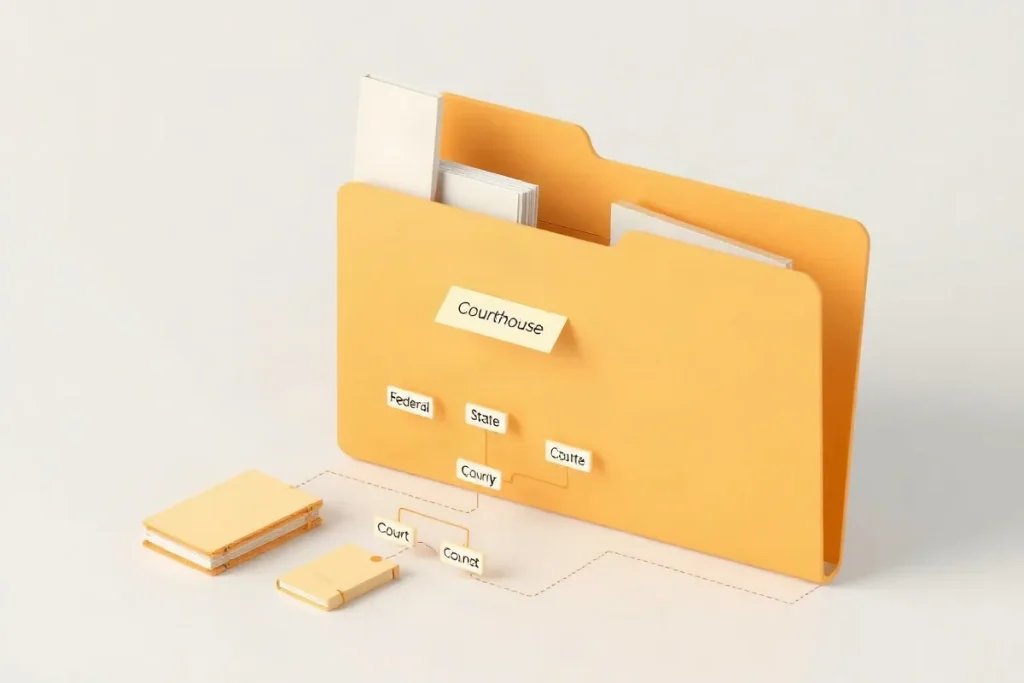
To find public court records, search the court system that handled the case, using its official case-search service or contacting the court clerk.
Start with the state or federal court where the case was filed. Court case lookup tools vary: you may need a person’s name, a case number, or the court location, and some records may not be available online. This guide explains how to narrow your search and what to check when a result is missing.
| Court system or record | Online route | In-person or request route |
|---|---|---|
| Federal case | PACER | Clerk’s Office at the courthouse where the case was filed |
| New Jersey case | NJ Courts public case databases | Request court records through NJ Courts |
| North Carolina case | Online court portals | Clerk of court’s office in the relevant county |
| New York probate record | No online route stated here | County Surrogate’s Court; appointment may be needed and a fee may apply |
How do you choose the right court system for a case lookup?
Choose the court system by case location and level: federal cases can be searched through PACER, while state and local cases use the relevant state or local court system.
- Federal case: Search Public Access to Court Electronic Records (PACER), or contact the Clerk’s Office at the courthouse where the case was filed.
- New Jersey case: If you know the state but not the court, start at the NJ Courts public page. It offers public case databases and a way to request court records.
- North Carolina case: Start with the clerk of court’s office in the county where the case is located, or search an online portal.
For a state or local case elsewhere, identify the court system for the place where the case was filed, then use that system’s case-search or records-request options. If you are unsure which court holds the case, the relevant county clerk’s office is a practical place to ask.
What details help you find the correct case record?
To find the correct court case record, identify whether it is in the state or federal system and, for a county-based case, which county handled it.
- Federal cases: Start with PACER, the federal courts’ case-search service. You can also ask the Clerk’s Office at the courthouse where the case was filed.
- State cases: Use the court system’s own case database or portal. The NJ Courts public page brings together public case searches and requests for court records.
- County records: If an online search does not locate the file, contact or visit the relevant Clerk’s Office or county clerk of court’s office. For North Carolina records, the county clerk’s office is one place to request access.
- New York probate: Check the Surrogate’s Court in the county where the probate record is filed and kept. Access may involve a courthouse visit; check with the court about appointments and fees.
How do you retrieve a file after finding a case?
After finding a case, use the relevant court’s access route: search PACER or contact the filing courthouse’s Clerk’s Office for a federal file, and request state records from the court that holds them.
- Federal cases: Search PACER for the case file, or ask the Clerk’s Office at the courthouse where the case was filed how to access the record.
- North Carolina: Request copies from the clerk of court’s office in the county where the case is located.
- New Jersey: The NJ Courts public page lets visitors search public case databases or request court records.
- New York probate: For wills and other probate records, contact or visit the county Surrogate’s Court. An appointment may be needed, and a fee may apply.
Before visiting a clerk’s office or Surrogate’s Court, check with that office about its copy-request process, appointment requirements, and any fees.
How should you read court statistics alongside case records?
Read the Ohio Supreme Court’s dashboard as a source of case statistics, not as a way to find an individual case. The court does not collect information on individual cases, so use a docket or case file when you need to inspect a specific matter.
The Ohio Supreme Court says users can contact its Case Management Section with questions about how complete the dashboard statistics are. That is the place to raise questions about what the statistics include.
The court’s Program Assistant can help correct reporting errors. Keep that correction process separate from looking up a particular case: a dashboard statistic and an individual case record serve different purposes.
When can a court case lookup fail or require another step?
A court case lookup can fail when you search the wrong state, county or court system, or when the document you need is not available online. Confirm where the case was filed before trying another database.
- Federal cases: Search through PACER or contact the Clerk’s Office at the courthouse where the case was filed.
- North Carolina cases: Search online or contact the clerk of court in the county where the case is located.
- Specific documents: A public case search does not guarantee that every related document is available online. You may need to request the particular record from the court.
New York probate records, including wills, are kept by the county Surrogate’s Court. Access may require an appointment and a fee, so check with that court before visiting.
How does the lookup process differ for probate, family and small claims cases?
Probate, family and small claims searches follow different routes: New York wills go to each county’s Surrogate’s Court, while family and small claims records require you to identify the state and local court that handled the case.
- Probate: In New York, wills are filed and kept by the Surrogate’s Court in the county. Check that court for its records access process; courthouse access may require an appointment and a fee.
- Family and small claims: Start with the state and the local court that handled the matter, then follow that court’s case-search or records-request process.
- New Jersey: NJ Courts provides public case databases and a way to request court records, making its public page a practical starting point.
A state’s general public court-records page can help you find the right search or request route, but the court and county determine which office holds the case file. Check the court’s location before submitting a records request.
Frequently asked questions
Where can I look up a federal court case?
Can I get a North Carolina court record online?
Where are New York probate records kept?
Do Ohio court statistics dashboards show individual cases?
Sources
- uscourts.gov — “Find a Case (PACER)”
- uscourts.gov — “Court Records”
- North Carolina Judicial Branch — “Obtaining Court Records”
- nycourts.gov — “Getting Court Records & Case Information”
- supremecourt.ohio.gov — “State of Ohio Court Statistics » Supreme Court of Ohio”