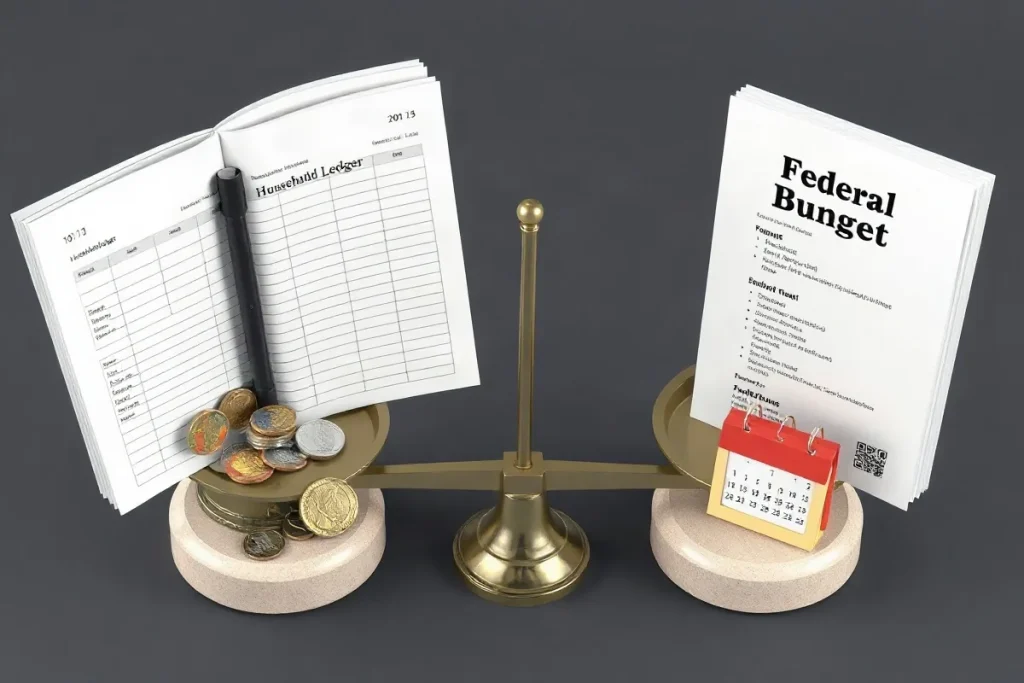
Federal budgets and household budgets follow different rules because the federal government can raise revenue, borrow and shape economic policy in ways a household cannot, while families must manage spending against their income and access to credit. The comparison is useful, but treating the government like a family can obscure how public finance works.
That distinction matters in debates over deficits, taxes and spending: a household usually has to balance its books over a limited period, whereas the federal budget reflects broader policy choices and obligations. Understanding where the analogy breaks down—and where careful budgeting still applies—makes the arguments easier to assess.
| Criterion | Household budget | Federal budget |
|---|---|---|
| Planning framework | 50/30/20 rule is one option | Recommendations, authorizations and appropriations |
| Spending authority | Household allocates its own funds | Annual appropriations fund discretionary programs |
| Borrowing and offsets | A household tracks income and bills | Rules seek offsets for new spending or tax cuts |
| Year-end incentive | No federal fiscal-year lapse rule | Agencies may rush to spend unspent funds |
- 50/30/20 Household budgeting rule dividing income among essentials, wants and savings
- 4.9 times Federal agency spending in the final week of the fiscal year compared with a typical week during the rest of the year, as reported by the NBER Digest
- 3 stages Federal budget process elements named in the provided summary: recommendations, authorizations and appropriations
Why can the federal government borrow when households usually try to balance a budget?
The federal government can borrow to cover a gap between revenue and spending because its budget operates through a public process of recommendations, authorizations and appropriations—not a household rule for dividing income. A household may use the 50/30/20 rule to organize income among essentials, wants and savings, but that rule is not a federal budgeting formula.
A household plan is a spending guide
A household budget helps decide how to allocate income; the 50/30/20 approach is one possible guide, not a requirement. Its categories—essentials, wants and savings—describe personal choices, whereas federal spending is shaped by distinct budget procedures and programs.
Federal borrowing is part of the budget framework
The federal process separates recommendations from authorizations and appropriations, so a household-style balancing rule does not determine every spending decision. Borrowing can finance a difference between federal revenue and spending; calling that difference the same as a household shortfall overlooks how federal decisions are made.
- Household: the 50/30/20 rule offers a way to organize income among essentials, wants and savings.
- Federal government: recommendations, authorizations and appropriations structure decisions, while borrowing can cover a revenue-spending gap.
What do federal budget resolutions actually control?
A federal budget resolution sets overall spending totals, but those totals generally do not govern legislation that establishes or changes rules for programs funded through annual discretionary appropriations. The distinction is between setting budget-wide limits and deciding how a particular program works.
Authorization is not appropriation.
An authorization can create or revise a program’s rules without providing the annual funds needed to operate it. For programs supported by discretionary appropriations, Congress must separately provide that funding through the annual appropriations process.
- Discretionary programs: An authorization may set or change program rules, while an annual appropriation supplies the funds.
- Entitlement programs: The budget-resolution distinction changes when legislation alters an entitlement, such as Medicare or SNAP.
Medicare and SNAP illustrate why the distinction matters: legislation changing an entitlement is treated differently from an authorization that only changes rules for a program funded through annual appropriations. The key question is therefore not simply whether legislation concerns federal spending, but whether it changes an entitlement or addresses a program whose funding Congress provides annually.
How do federal budget rules treat new spending and tax cuts?
Federal budget enforcement rules generally require new spending or tax cuts to be offset by spending reductions or revenue increases, but the promised offset must actually take effect. Unlike a household, which can adjust its monthly budget when a bill arrives, Congress must build federal offsets into legislation and rely on those provisions to deliver the savings or revenue.
The timing of offsets matters.
The Committee for a Responsible Federal Budget warns that a plan can raise borrowing when it puts costs first and savings later: delayed offsets are less likely to materialize, even as the initial spending or tax cuts increase borrowing. The risk is about the sequence and reliability of the provisions, not simply whether a bill claims to be paid for.
- Household budget: A person can respond to a monthly bill by changing later spending; the adjustment is a direct choice within that budget.
- Federal budget: An offset depends on legislative design and whether its spending reductions or revenue increases take effect. Under the federal process, totals in a budget resolution do not apply to authorizing legislation for annually appropriated programs unless that legislation changes an entitlement program, such as Medicare or SNAP.
What drives federal spending differently from a household’s bills?
Population and health costs shape federal outlays.
Federal spending is driven chiefly by an aging population and rising health care costs per person, rather than by every program growing together. The federal-budget summary says mandatory spending outside Social Security and health care is expected to decline, including safety-net programs such as nutrition assistance.
- Federal budget: Social Security and health care are the major pressures identified in the summary; other mandatory spending is expected to fall.
- Household budget: The 50/30/20 approach sorts income among essentials, wants and savings, leaving room to trade off one essential against another.
A household can respond to a high rent bill by choosing cheaper transport, or make a different balance between essentials and other spending. Federal outlays follow program rules and demographic and health-cost pressures instead: shifting money between categories does not by itself change the obligations built into Social Security or health care programs. That is why the household framework is a budgeting choice, while federal spending patterns reflect both policy commitments and the costs of serving an aging population.
When do household budgeting rules and federal rules mislead?
The household analogy has limits
The 50/30/20 rule can guide a household’s choices, but it is neither a statutory federal spending limit nor a rule for congressional appropriations. Federal spending also moves through distinct stages, so a budget resolution does not govern every program in the same way.
- Household planning: The 50/30/20 rule divides a household budget among needs, wants and savings; it is a planning philosophy.
- Federal programs: Annual appropriations fund many discretionary programs, while authorizing legislation establishes or changes program rules. Budget-resolution totals generally do not apply to that authorizing legislation unless it changes an entitlement program.
Year-end spending incentives
Federal agencies can face pressure to spend funds before they expire, creating a different incentive from a household’s effort to carry savings forward. The NBER Digest reports that agencies spend an average of 4.9 times more in the final week of the fiscal year than in a typical week during the rest of the year.
That year-end surge reflects a trade-off in rules designed to prevent appropriated funds from lapsing unused: they may encourage rushed purchases and potential waste. The 4.9-times figure describes a pattern, not proof that every late-year purchase is wasteful; it does show why household budgeting analogies cannot capture all the incentives built into federal spending rules.
Questions readers ask
Does a federal budget resolution set every agency’s spending?
Do federal budget rules require offsets for new spending?
What are the main forces identified as driving federal spending?
Why might agencies spend more at the end of the fiscal year?
Key takeaways
- The 50/30/20 rule is a household guide, not a federal budget formula.
- Federal budget resolutions do not control every authorizing bill.
- Budget enforcement rules seek offsets for new spending and tax cuts.
- An aging population and health care costs are major federal spending drivers.
- The NBER Digest reports a 4.9-times year-end spending spike relative to a typical week.
Sources
- cbpp.org — “Introduction to the Federal Budget Process”
- crfb.org — “Playing By the (Budget) Rules: Understanding and Preventing Budget Gimmicks-Mon, 02/26/2018 – 12:00 | Committee for a Responsible Federal Budget”
- House Budget Committee Democrats — “Frequently Asked Questions about the Federal Budget”
- American National Bank of Texas — “The 50/30/20 Budget Rule”
- NBER — “Use-It-or-Lose-It Budget Rules”
