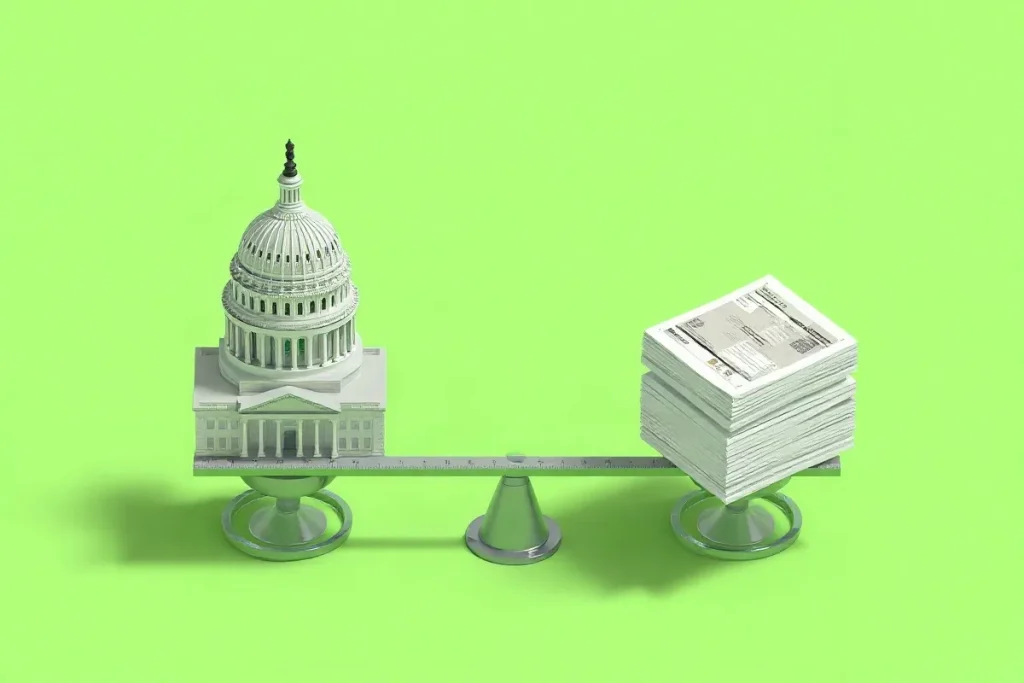
A bill’s cost estimate becomes a budget argument when lawmakers use its projected effects on federal spending or revenue to debate whether the proposal is affordable, who should pay, and what trade-offs it requires. The estimate does not decide those questions; it gives Congress a fiscal frame for contesting them.
That frame can shape a bill’s prospects as much as its policy goals. The estimate turns proposed choices into budget consequences, giving supporters and opponents a common set of numbers to argue over—and making assumptions about costs, savings and timing part of the legislative fight.
| Question | Estimate provides | Do not assume |
|---|---|---|
| Comparison | Proposed policy versus current-law baseline | Comparison with an unchanging present-day budget |
| Time | Effects over the period analyzed | A final account of all later years |
| Scope | Federal spending and revenue effects | Every social or economic consequence |
| Certainty | A forecast shaped by assumptions | Guaranteed actual spending or revenue |
What does a federal bill’s cost estimate measure?
The Congressional Budget Office (CBO) estimates how a proposed bill would change federal spending and revenues compared with a projection in which the bill does not take effect. Its estimate is therefore a comparison with a no-bill baseline, not a single price tag detached from that alternative.
A CBO cost estimate applies to a defined proposal: the bill’s provisions, effective dates and eligibility rules shape what the agency projects. Changing who qualifies or when a provision begins can change the estimated budget effects, even when the bill’s broad purpose stays the same.
What the estimate covers—and what it cannot show
A cost estimate projects effects over a stated period; it is not a receipt for the law’s eventual cost. It can cover both sides of the budget: direct spending, such as payments authorized by the proposal, and federal revenues, such as taxes affected by its provisions. Those are distinct effects, so the estimate may describe spending increases alongside revenue changes rather than compressing them into one all-purpose figure.
How does CBO build a bill’s estimate?
Baseline
The Congressional Budget Office (CBO) estimates a bill’s budget effects by comparing the proposal with a projection of federal spending and revenues under current law. That baseline is the reference point: the estimate describes how the bill would change projected spending or revenue over the period covered by the analysis, rather than treating the proposal’s totals in isolation.
Policy effects
CBO analysts identify the bill’s provisions that would alter current law, then estimate the budget effect of those changes over the analysis period. For spending provisions, eligibility rules and the date benefits begin can affect how many people qualify and when federal costs arise. For revenue provisions, analysts consider how the proposed tax-rule changes affect collections and compare those amounts with the revenue projected under current law.
Which assumptions can move the estimate?
A bill’s cost estimate can shift when analysts change the projected current-law baseline, the years covered, eligibility and benefit rules, or assumptions about economic and behavioral responses. Each choice changes what the proposal is compared with and how much activity it is expected to affect.
The current-law baseline projects spending and revenues under existing law; it is not a frozen snapshot of today’s budget. Effective dates then determine which fiscal years capture a provision: a change taking effect immediately enters the forecast window differently from one scheduled to begin later. A delayed start can leave earlier years untouched while still affecting later projected years.
Who is covered, and how they respond
Eligibility thresholds and benefit rules define who qualifies and what the government pays—or collects—for each covered person or transaction. A threshold set at a particular income level, for example, draws a different boundary from a rule with no income test. For policies that may influence decisions, such as whether a person works or a business invests, the estimate also depends on assumptions about those responses; it is conditional on them, not a guaranteed outcome.
Why do lawmakers turn a score into a budget argument?
Lawmakers turn a Congressional Budget Office (CBO) score into a budget argument because it gives them a shared comparison: a bill’s projected budget effects measured against the baseline. That comparison lets members debate whether the proposal fits their fiscal priorities without having to agree that its policy goals are desirable.
Disagreement can concern the forecast period or assumptions used to estimate the bill’s effects, not just the arithmetic. Those choices shape what the projected total captures, so a score is most useful when lawmakers and the public can see what lies behind it.
What a score can—and cannot—decide
A CBO estimate can inform legislative choices, but it cannot determine whether a proposal is worthwhile. That judgment also depends on the policy’s intended effects, which are distinct from its projected budget impact. For the public, the key questions are what total is projected, which provisions drive it, and which assumptions shape the estimate.
When is a cost estimate not the final price?
What the score does not settle
A bill’s cost estimate is not the final price: it is a projection of federal budget effects under specified assumptions, not an audited account of what the government later spends or collects. Actual outcomes can diverge if those assumptions do not hold. The estimate also does not measure every social or economic consequence of the law.
A score applies to the bill text and forecast period analyzed. If amendments change the text, or implementation changes how its provisions work, the earlier estimate may no longer describe the revised policy. A single total can also conceal which provisions were counted and when they take effect.
- Baseline: Check the comparison point used to calculate the projected budget effect; the total is meaningful only against that baseline.
- Effective dates: Check when each provision begins, since a change taking effect later may fall outside part of the forecast period.
- Covered provisions and forecast period: Confirm which parts of the bill and which years the score includes before treating its total as the cost of the whole law.
How should readers check a published score?
Readers should verify that a published score is a Congressional Budget Office (CBO) estimate for the exact version of the bill under discussion, then check its baseline and fiscal-year coverage before treating the total as a standalone cost. A CBO estimate is tied to a particular legislative text; a score for an earlier version may not reflect later changes.
The CBO estimate’s baseline comparison explains what the projected change is measured against, while the fiscal years identify the period covered. Check both before comparing two totals: estimates covering different periods or using different baselines do not describe the same budget effect. Then review which spending and revenue provisions the estimate includes, whether eligibility rules change, and what assumptions CBO identifies.
Keep the estimate distinct from outcomes and policy judgments
A CBO score is a projection of the bill’s federal budget effect, not a record of later actual spending or revenue. Actual results can differ from projections, and a budget estimate alone does not determine whether a policy is effective, fair or worthwhile. Readers should keep those questions separate when a published score is used in a broader budget argument.
Frequently asked questions
Does a cost estimate capture every effect of a bill?
Key takeaways
- CBO scores proposed changes against a current-law baseline.
- Effective dates, eligibility rules and forecast assumptions shape the estimate.
- A projected federal budget effect is not a final accounting of actual results.
- Check the bill version, baseline and fiscal years before citing a score.