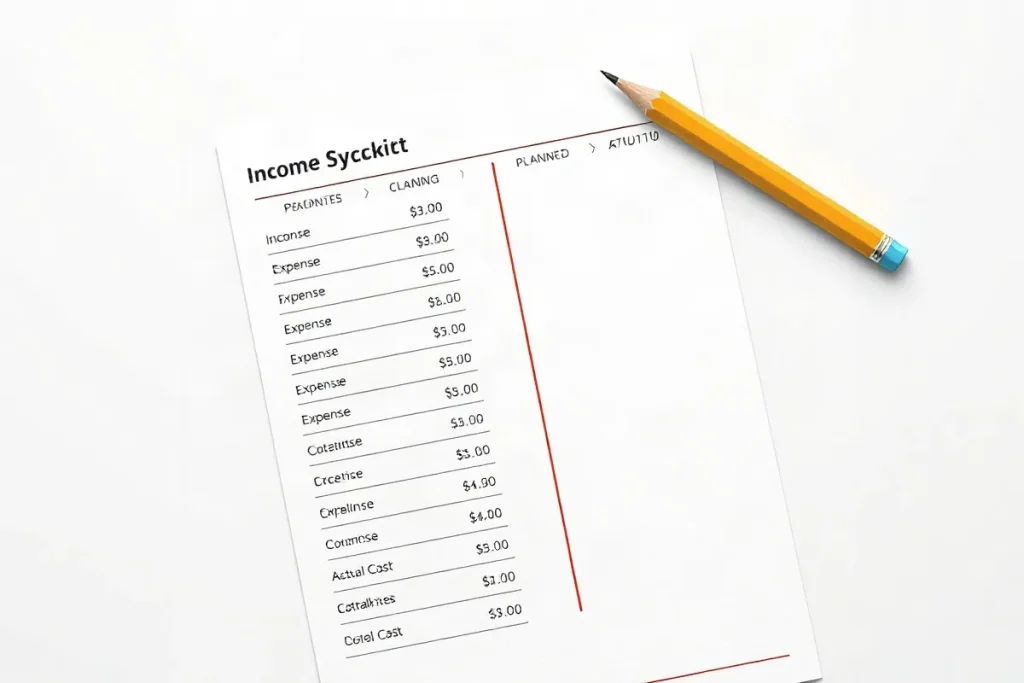
A budget template turns your income and expenses into a spending plan. List what comes in, set aside money for essential bills and savings, then plan how to use what remains.
The best template is one you can keep current: make room for regular costs, changing expenses and unexpected bills. This guide explains how to build a spending plan around your priorities and adjust it when real life does not match the numbers.
| Decision | What to enter | What to check |
|---|---|---|
| Everyday personal spending | Income, essential costs and discretionary costs | Planned amount versus actual spending |
| Shared household costs | Groceries, utilities and childcare | Which expenses are shared |
| Truck rental | A separate one-off expense | Final cost against estimate |
| Budget Bytes recipe | The related grocery spending | Actual household food costs |
| Budget Blinds purchase | A separate home-purchase cost | Current provider quote |
| Grant budget | Costs under the funder’s categories | Applicable grant terms and indirect-cost rules |
- 15% Russell Sage Foundation indirect-cost cap on grants over $75,000
- $75,000 Grant threshold above which the Russell Sage Foundation covers indirect costs
What belongs in a budget template?
A useful budget template lists income, essential expenses, discretionary spending, planned and actual costs, and a total that shows your current balance.
Start with income, then enter essential costs such as rent and groceries. Add discretionary spending, including entertainment and hobbies, so the worksheet shows where your money is expected to go.
- Planned amount: Record what you expect to spend on each cost.
- Actual amount: Enter what the cost ends up being. The difference between the planned and actual amounts shows which estimates may need adjusting.
- Income and expense total: Use the worksheet’s total to compare income with expenses and see your current balance.
Choose an editable format
Excel and Google Sheets are practical choices when you want to edit categories and have calculations update automatically. Keep categories specific enough to distinguish essentials such as groceries from discretionary costs such as hobbies.
The Russell Sage Foundation covers indirect costs of up to 15% on grants over $75,000 only. If you are preparing a budget for one of its grants, check that limit when entering indirect costs.
Why does a budget fail when estimates replace actual costs?
A budget fails when estimates stand in for actual costs because the plan hides overruns and leaves you adjusting spending against numbers that never reflected what you paid.
Estimate versus actual
Track an estimate beside the final cost for each item. The estimate helps you plan; the actual figure shows what the item cost. Review the difference and use it to revise the next budget instead of treating the original estimate as fixed.
- Truck rental: Enter the expected rental expense as its own moving cost, then replace the estimate with the final charge.
- Groceries: Budget Bytes recipes can help you decide what to cook or buy, but a recipe price is not the household’s full grocery bill. Track what your household actually spends on groceries.
Keeping these costs distinct makes the next plan more useful: a rental charge reflects the move, while grocery spending reflects the household’s real shopping.
How should you adapt a budget template to a household or a major change?
Adapt a budget template by changing its rows to match who shares costs, what has changed, and whether you are tracking daily spending or a longer-term goal.
A personal budget can follow routine purchases as well as goals you plan for over time. For a household budget, give shared groceries, utilities and childcare their own rows so you can distinguish joint costs from other spending.
Update the plan when circumstances change
Marriage, having children or changing jobs can affect both income and expenses. Update the relevant rows to reflect the new situation instead of carrying forward assumptions from an earlier budget. A job change, for example, may mean revising income and the expenses tied to work or household routines.
Use a spreadsheet to test a proposed change before committing: enter the expected income and costs, then compare that scenario with actual spending as circumstances develop. Revise the plan when the real figures differ from what you expected.
For a home purchase from Budget Blinds, enter the expected purchase cost as a separate planned expense, not as a recurring household bill. Later, compare the estimate with what you actually spend.
How should you handle a budget that covers more than one year?
Handle a budget that spans more than one year by setting a separate plan for each period and scheduling updates when its assumptions may change.
North Carolina operates under a biennial (two-year) budget that begins on July 1 of each odd-numbered year, with annual updates to the second year of the enacted budget. Its approach shows why a multi-year plan may need a planned revision rather than one total that stays fixed.
For a personal or household budget, keep the assumptions for each period visible: expected income, regular expenses and planned spending. Compare those estimates with what actually happens, then revise the relevant period when income, expenses or the decision itself changes. A spreadsheet makes it easier to keep the original plan distinct from later updates.
When does a simple spending template need a different set of rules?
A spending template needs different rules when it is tracking household choices rather than costs governed by a grant: grant budgets can limit eligible expenses and separate direct from indirect costs.
Check the rules before reusing a template.
The Russell Sage Foundation covers indirect costs of up to 15% only on grants over $75,000. That is a grant-specific rule, not a household budgeting standard, and it should not be transferred to another funder’s application.
- For a grant: Check the relevant grant terms for eligible costs, direct and indirect expense rules, and any cap.
- For a household: Use categories that reflect your own spending; do not copy a grant’s indirect-cost limit.
A household purchase such as Budget Blinds calls for a different check. A template can keep your planned amount and actual cost organized, but it does not set the provider’s current price.
Before entering the actual cost, confirm the quote from Budget Blinds.
Frequently asked questions
What is a budget template?
Should a budget template include both planned and actual spending?
Can I use one budget template for a household and a project?
How do I budget for a one-off expense such as a truck rental?
Sources
- intuit.com — “Budget Template: Learn How to Create One for Effective Planning”
- asana.com — “All-Purpose Budget Template That's Ready for Anything [2026] • Asana”
- Ally — “Free Financial Budget Templates”
- Microsoft Excel — “Free budget template spreadsheets to customize”
- personalfinance.duke.edu — “Budgeting & Spending Plans | Office of Student Loans & Personal Finance”