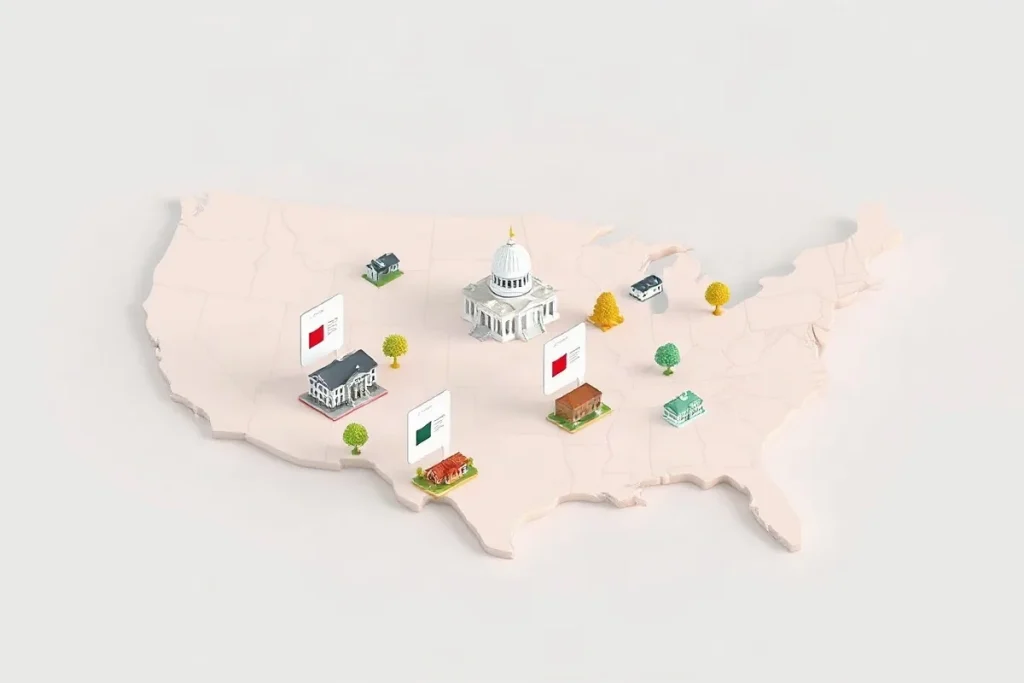
Federalism fundamentally structures the interaction between state and national governments by dividing powers and responsibilities, allowing both levels to operate independently while also collaborating on shared issues. This system creates a dynamic balance where authority is distributed, negotiated, and sometimes contested, shaping policy outcomes across the United States.
Understanding how federalism shapes state and national government interaction is essential to grasping American governance. It influences everything from lawmaking and budget priorities to crisis management and civil rights enforcement. The ongoing negotiation of power helps explain why states often respond differently to national policies and why the federal government sometimes steps in to set uniform standards.
As political and social challenges evolve, so too does the relationship between states and the federal government under federalism. This complex interplay defines much of the political debate and policy innovation in the United States, highlighting the importance of this constitutional framework in balancing unity with regional diversity.
| Policy Area | Federal Role | State Role | Example |
|---|---|---|---|
| Education | Sets federal standards, provides grants | Operates schools and curricula | 13,500 school districts managed by states |
| Healthcare | Funds Medicaid with matching rates | Administers Medicaid programs | Medicaid is 16% of state spending |
| Public Safety | Supports federal law enforcement | Manages local police departments | Local police funded $350 per capita |
| Transportation | Funds infrastructure grants | Maintains roads and bridges | Infrastructure Act gave $110B to states |
| Elections | Sets standards (Help America Vote Act) | Runs elections independently | Diverse voting systems by state |
- $750 billion Federal grants to states and localities in FY2025
- 16% Share of state budgets spent on Medicaid
- $350 per capita Average annual local funding for police services
- $7.25 to $15.50 per hour Range of state minimum wages in 2026
- 1.3 million Families served by TANF in 2025
How does federalism determine the division of governance responsibilities?
Constitutional Basis
Federalism determines governance responsibilities by allocating specific powers to the national government while reserving others for the states, as explicitly established in the U.S. Constitution. The Constitution grants the federal government authority over national defense and interstate commerce, among other areas, whereas the Tenth Amendment, ratified in 1791, specifically reserves all powers not delegated to the federal government to the states or the people. This constitutional framework creates a clear legal foundation for dividing responsibilities, ensuring that states retain control over functions such as education policy and local law enforcement.
Practical Division of Services
In practice, states and the federal government manage distinct but sometimes overlapping functions. For example, in 2026, states collectively oversee more than 13,500 public school districts responsible for K-12 education, a role primarily delegated to state and local governments. On the federal level, agencies like the Federal Emergency Management Agency (FEMA) coordinate disaster response nationwide. However, states maintain substantial independent authority in disaster management: California, for instance, allocates over $1.2 billion annually for wildfire prevention and response, demonstrating how states manage critical services tailored to local needs.
- Federal powers include defense and interstate commerce as per the U.S. Constitution.
- States manage over 13,500 school districts for K-12 education in 2026.
- California spends $1.2 billion annually on wildfire management independent of FEMA.
What role do federal grants play in shaping state policies?
Grant Funding Impact
Federal grants play a crucial role in directing state policies by providing essential funding that shapes priorities in key sectors such as healthcare and infrastructure. In fiscal year 2025, the federal government allocated roughly $750 billion in grants to states and localities, significantly influencing state-level decisions. For example, Medicaid, a joint federal-state program, constitutes about 16% of total state expenditures, with federal matching rates ranging typically from 50% to 75% depending on each state’s income. This substantial federal contribution incentivizes states to align their healthcare policies and eligibility criteria with federal guidelines to secure funding.
Conditions and Compliance
Federal grants often come with conditions that states must meet to access or maintain funding, thereby shaping state policy frameworks. The Infrastructure Investment and Jobs Act of 2021, which dedicated $110 billion to states for roads and bridges, requires states to comply with federal standards on project eligibility and reporting. These conditions ensure that state projects meet national goals for safety, environmental impact, and efficiency, effectively steering state infrastructure planning and execution.
- Medicaid federal matching rates: 50% to 75% depending on state income
- Fiscal year 2025 federal grant distribution: approximately $750 billion
- Infrastructure Investment and Jobs Act (2021) allocation: $110 billion for roads and bridges
- Compliance requirement: adherence to federal standards for project eligibility
How does federalism affect policy innovation and experimentation at the state level?
Examples of State-led Innovation
Federalism enables states to serve as testing grounds for policy innovation and experimentation, allowing them to tailor solutions to local needs before potential national adoption. Massachusetts’ 2006 health insurance mandate, which required nearly all residents to obtain health coverage, set a precedent later influencing the federal Affordable Care Act. Similarly, Colorado’s early legalization of recreational cannabis in 2012 demonstrated how state autonomy can produce diverse policy outcomes despite ongoing federal prohibition under the Controlled Substances Act. As of 2026, 20 states have legalized recreational cannabis, showcasing significant variation in drug policy within the federal system.
Federal Encouragement of Experiments
The federal government also actively promotes state experimentation through targeted incentives and funding programs. The 2023 Competitive Services Market Act allocates grants averaging $5 million per project to encourage states to pilot renewable energy technologies. This financial support enables states to test innovative approaches in energy transition, from solar grid integration to battery storage solutions. By fostering such localized experimentation, federalism balances national goals with state-level flexibility, allowing diverse models to emerge and inform broader policy decisions.
- Massachusetts’ 2006 health insurance mandate as a precursor to federal reform
- Colorado’s 2012 cannabis legalization, part of a 20-state trend by 2026
- Competitive Services Market Act (2023) grants averaging $5 million per renewable energy pilot
When does federalism create conflicts or inefficiencies between state and national governments?
Legal and Regulatory Disputes
Federalism can generate conflicts when state and national governments assert competing legal authority, leading to court challenges and enforcement uncertainty. In 2024, more than 30 states filed lawsuits against federal vaccine mandates, highlighting disputes over public health jurisdiction and individual rights. Such litigation delays policy implementation and creates a patchwork of compliance standards that complicates governance at both levels.
Operational Challenges
Differences in state regulations also create inefficiencies for businesses operating across multiple jurisdictions. For example, variations in environmental rules can increase costs for multistate companies by an estimated 3-5%, as reported in industry analyses from 2024. Additionally, inconsistent COVID-19 guidelines between federal agencies and state governments during the pandemic slowed coordinated public health responses, prolonging outbreaks in major metropolitan areas by several weeks.
- Legal conflicts: 30+ states challenged federal mandates in 2024, delaying enforcement.
- Business impact: 3-5% rise in operational costs due to differing state environmental regulations.
- Public health: COVID-19 response delays in key metros linked to inconsistent federal and state guidelines.
How does federalism influence the delivery of citizen services at state and local levels?
Public Assistance and Safety
Federalism shapes citizen services by delegating most public assistance and safety responsibilities to state and local governments, resulting in varied program administration and funding across the country. State governments manage roughly 90% of public assistance programs, including Temporary Assistance for Needy Families (TANF), which supported nearly 1.3 million families nationwide in 2025. This decentralized control allows states to tailor eligibility and benefits but also creates disparities in service levels.
Local police departments, funded primarily through state and local taxes averaging about $350 per capita annually, illustrate federalism’s impact on public safety. Because states and municipalities set policies independently, law enforcement practices and resource allocation differ widely, reflecting local priorities and fiscal capacities. This variation means citizens experience substantially different levels of public safety services depending on their state or city.
Election Administration
The federalist system also influences election administration by requiring federal standards while leaving operational control to states. The Help America Vote Act of 2002 establishes national guidelines for voting systems and procedures but entrusts states with their implementation. Consequently, states adopt diverse voting technologies and processes, resulting in a patchwork of election experiences nationwide.
- Temporary Assistance for Needy Families (TANF): Served nearly 1.3 million families nationwide in 2025
- Local police funding: Approximately $350 per capita annually from state and local taxes
- Help America Vote Act (2002): Federal standards mandate uniform election requirements but allow varied state-level administration
What are common misconceptions or limitations of federalism in practice?
Limits to State Power
Federalism does not provide states with absolute sovereignty since federal law takes precedence under the Supremacy Clause of the U.S. Constitution. This principle was firmly established in the 1819 Supreme Court case McCulloch v. Maryland, which confirmed that states cannot override valid federal laws. Thus, while states have significant autonomy, their policies must comply with overarching federal mandates, limiting state authority especially in areas like immigration, interstate commerce, and civil rights.
Impact of Resource Variation
Disparities in state resources create significant differences in public services and economic conditions across the country. For example, minimum wage rates vary widely in 2026, ranging from the federal baseline of $7.25 per hour to $15.50 in California, reflecting differing economic policies. Similarly, education funding per capita differs markedly, with Idaho spending about $7,000 compared to New York’s $22,000 in 2024, contributing to unequal educational opportunities nationwide.
- Minimum wage: $7.25 federal baseline to $15.50 in California (2026)
- Per capita education spending: $7,000 in Idaho vs. $22,000 in New York (2024)
Frequently asked questions
What constitutional provision defines federalism in the U.S.?
How much federal funding do states rely on for healthcare?
Can states override federal laws under federalism?
Do all states have the same election procedures?
Key takeaways
- Federalism allocates governance between national and state governments under constitutional limits.
- Federal grants significantly influence state policy priorities and compliance.
- State autonomy enables policy innovation, such as in healthcare and cannabis legalization.
- Conflicts arise when state and federal policies or mandates diverge.
- Variations in resources and laws affect citizen services across states.
