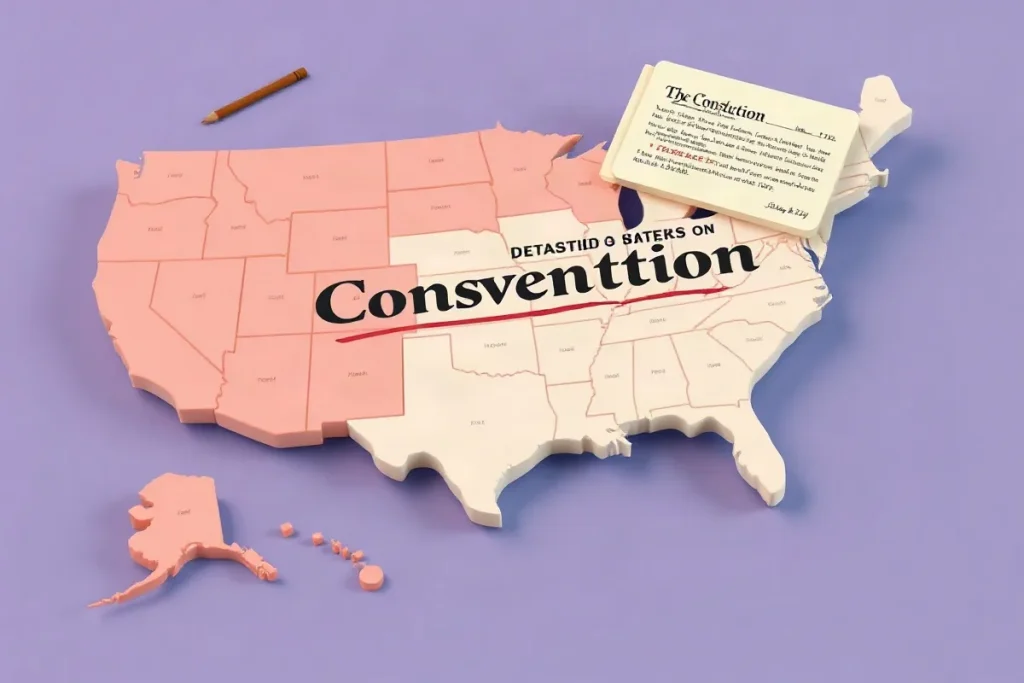
A Convention of States convened under Article V of the U.S. Constitution could fundamentally alter the balance of federal power by enabling states to propose amendments that limit federal authority or impose new constraints on national institutions. This process, driven by state legislatures rather than Congress, offers a pathway for states to reclaim influence over federal governance.
As debates over federal overreach and states’ rights intensify, the idea of an Article V Convention of States has gained traction among policymakers and activists seeking structural change. Unlike traditional constitutional amendments initiated by Congress, this mechanism empowers states directly to address perceived imbalances in Washington’s scope and reach, potentially reshaping the federal system itself.
Understanding how a Convention of States works, its legal framework, and the political dynamics involved is essential to grasping its potential impact. This article explores the mechanisms behind an Article V Convention, the historical context, and the implications for the future distribution of power between states and the federal government.
| Method | Trigger Threshold | Proposal Authority | Ratification Requirement |
|---|---|---|---|
| Congressional Proposal | None | Congress (2/3 majority in both houses) | 38 states (3/4) approval |
| Convention of States | 34 states applications | Delegates at convention called by Congress | 38 states (3/4) approval |
- 34 states Number of states required to call a Convention of States
- 38 states Number of states required to ratify proposed constitutional amendments
- 3% annual spending growth Example cap proposed in fiscal restraint amendments
- 12 years Typical term limit proposed for members of Congress
- 19 states States that had applied for a Convention of States as of 2026
What is a Convention of States under Article V and how is it triggered?
The Article V Amendment Process
A Convention of States under Article V is a constitutional mechanism allowing amendments to be proposed either by Congress or by a convention called upon request from two-thirds of state legislatures, which currently means 34 states. Since 1789, no such convention has occurred, making this an untested but constitutionally authorized route for constitutional change.
Article V specifies two methods to propose amendments: (1) a two-thirds vote in both the House and Senate, or (2) a convention convened after 34 state legislatures submit applications on the same or similar subjects. Upon reaching that threshold, Congress is constitutionally required to call the convention. This process empowers states to initiate federal constitutional changes independently of Congress.
State Applications and Thresholds
As of September 2026, 19 states have submitted applications requesting a convention focused on fiscal restraint and limiting federal power, according to the National Conference of State Legislatures. To trigger the convention, applications must reach the 34-state threshold on the same subject matter, which has not yet happened.
- Number of states needed: 34 state legislatures (two-thirds of 50 states)
- Current applications: 19 states applied by 2026 for a convention on fiscal limits
- Congress’s role: Must call the convention after threshold is met
- Historical precedent: No Article V convention called since 1789
How does the legal process for a Convention of States work in practice?
Calling the Convention
The legal process for a Convention of States begins when 34 states formally apply for one, at which point Congress is constitutionally required to call the convention. This threshold of 34 states represents just over two-thirds of the current 50 states. However, the U.S. Constitution does not specify detailed procedural rules for how Congress must organize or conduct the convention, creating uncertainty in its operation. For example, while Congress must convene the convention after the threshold is met, it remains unclear whether Congress controls agenda-setting or delegate credentials. The Texas Legislature’s 2026 resolution authorizing up to 28 delegates to participate illustrates how states are preparing for potential conventions, but the overall framework at the federal level is largely undefined.
Delegate Selection and Ratification
States typically appoint delegates to represent them at the Convention of States, with many choosing state legislators. The Texas Legislature’s authorization of 28 delegates in 2026 exemplifies this common practice. After the convention proposes amendments, these proposals must be ratified by three-fourths of the states—currently 38—to become part of the Constitution. Legal scholars remain divided over whether the convention’s scope can be limited to specific issues or whether it could transform into a “runaway convention,” exercising broader authority beyond its initial mandate.
- Threshold to call convention: 34 states (over two-thirds)
- Delegate example: Texas Legislature authorized 28 delegates (2026)
- Ratification requirement: 38 states (three-fourths) must approve amendments
- Legal debate: Limited scope versus runaway convention concerns
What specific changes could a Convention of States propose to shift federal and state power?
Fiscal Restraints
A Convention of States could propose amendments to enforce fiscal discipline by mandating a balanced federal budget and limiting spending growth to a fixed percentage of GDP, such as a maximum 3% annual increase. Such fiscal restraints aim to curb federal deficits and debt accumulation, addressing concerns over the national debt, which reached over $33 trillion in 2026. The balanced budget amendment would legally require Congress to not spend beyond its income except under specified emergency conditions, making federal financial management more predictable and state budgets less overshadowed by federal borrowing.
Federal Office Term Limits
Proposals also frequently include imposing term limits on federal officials to reduce entrenched incumbency and increase political accountability. A common suggestion is a 12-year total cap for members of Congress, whether served consecutively or non-consecutively. This would apply to both the House of Representatives and the Senate, potentially reshaping legislative experience and turnover rates. Term limits could also extend to federal executive appointees to limit prolonged bureaucratic control. Such measures seek to restore power balance by preventing long-term federal officeholders from dominating policymaking.
- Balanced budget amendment requiring no deficits except during presidentially declared emergencies
- Federal spending growth capped at 3% of GDP annually
- Maximum of 12 years total service for members of Congress
- Possible term limits on executive federal agency heads to reduce regulatory entrenchment
- Clarification and expansion of Tenth Amendment powers to reinforce state sovereignty
What are the risks, limitations, and common misconceptions about a Convention of States?
Runaway Convention Concern
A major risk of a Convention of States under Article V is the possibility of a “runaway convention,” where delegates exceed their original mandate and propose changes beyond the intended scope. Since the only historical precedent—the 1787 Constitutional Convention—resulted in a complete overhaul rather than targeted amendments, there is no clear example to reassure states or the public. This uncertainty has led some states to rescind their applications, including New York’s withdrawal in 2023, citing fears of losing control over the process or facing unintended constitutional alterations.
Legal and Political Uncertainties
The legal framework governing a Convention of States remains ambiguous, as courts have not definitively ruled on how to limit the convention’s agenda or enforce procedural rules. While any proposed amendments must still be ratified by 38 states to become effective, making radical change difficult, the lack of clarity fuels political apprehension. This uncertainty contributes to ongoing debate about whether the process could disrupt federal stability or be manipulated for partisan goals.
- 38 states required to ratify any amendments proposed by the convention
- New York rescinded its application in 2023 due to concerns over control and scope
- No judicial rulings definitively limiting a convention’s agenda or procedures
- 1787 Constitutional Convention as the sole precedent, noted for exceeding original mandates
What alternatives exist to a Convention of States for amending the Constitution?
Congressional Proposal Process
The primary alternative to a Convention of States for amending the U.S. Constitution is the Congressional proposal method, which requires a two-thirds majority vote in both the House of Representatives and the Senate. This established route was used to propose the 27th Amendment in 1789, which was eventually ratified in 1992. To date, all 27 amendments to the Constitution have originated from Congress, reflecting a high but achievable threshold of bipartisan consensus. The process involves drafting, debating, and passing a joint resolution, after which the amendment must be ratified by three-fourths (currently 38) of the 50 state legislatures or by state conventions, depending on Congress’s directive.
State and Judicial Alternatives
Beyond formal constitutional amendments, state legislatures wield significant power to implement policy changes within their existing authority, often avoiding the complexity of constitutional reform. For example, states can enact laws affecting education, healthcare, and taxation that incrementally shape federal-state relations. Citizen initiatives at the state level can influence federal policy indirectly but lack the authority to amend the Constitution. Meanwhile, the Supreme Court’s judicial interpretations frequently redefine the balance of federal and state power without constitutional amendments, as seen in landmark rulings like the 1992 case United States v. Lopez, which limited Congress’s Commerce Clause authority. These mechanisms provide alternative avenues for change without meeting the rigorous amendment thresholds.
- Congressional Amendment Proposal: Two-thirds majority in both houses required.
- Ratification Threshold: Approval by 38 state legislatures or conventions.
- State Legislative Action: Policy changes within state authority without constitutional amendments.
- Judicial Interpretation: Supreme Court rulings that redefine federal-state power balance.
Frequently asked questions
How many states must agree to call a Convention of States under Article V?
Has a Convention of States ever been held before?
Can a Convention of States propose any amendment it wants?
What happens after a Convention of States proposes amendments?
Key takeaways
- Article V requires 34 states to apply for a Convention of States.
- Amendments proposed need ratification by 38 states to take effect.
- No convention has been called since 1789, so procedures remain untested.
- Concerns about a runaway convention and unclear rules limit consensus.
- Alternatives include congressional amendment proposals and judicial interpretation.
